The world is moving into a technology-driven era where almost every industry uses technology in its work, and education is no exception; it has joined the race with smart classrooms.
Now you might wonder, “What is smart classroom?” or “Why do we need it?” and all sorts of other doubts, and that’s exactly why this blog is here to clear all your doubts about smart classrooms and how they are transforming the education system.
Quick Glance At the Blog
We hope the below tabular format makes it easy for readers to sift through the vital blog sections, such as the meaning and advantages of smart classrooms, along with equipment required and major differentiating factors with traditional classrooms. Look through the table below.
| Sections | Details |
| What Is A Smart Classroom? | Explains the meaning of smart classrooms |
| What are the advantages of smart classroom in modern education? | States the advantages of using smart classrooms for education. |
| What smart classroom equipment does K.R. Mangalam World School, Panipat? | Lists important equipment required to make a classroom smart. |
| What is the difference between traditional and smart classrooms? | Points out major differences with old-school and traditional classrooms. |
| Conclusion | Concluding statement of the write-up. |
| Frequently Asked Questions | Answers common questions about smart classrooms. |
What Is A Smart Classroom?
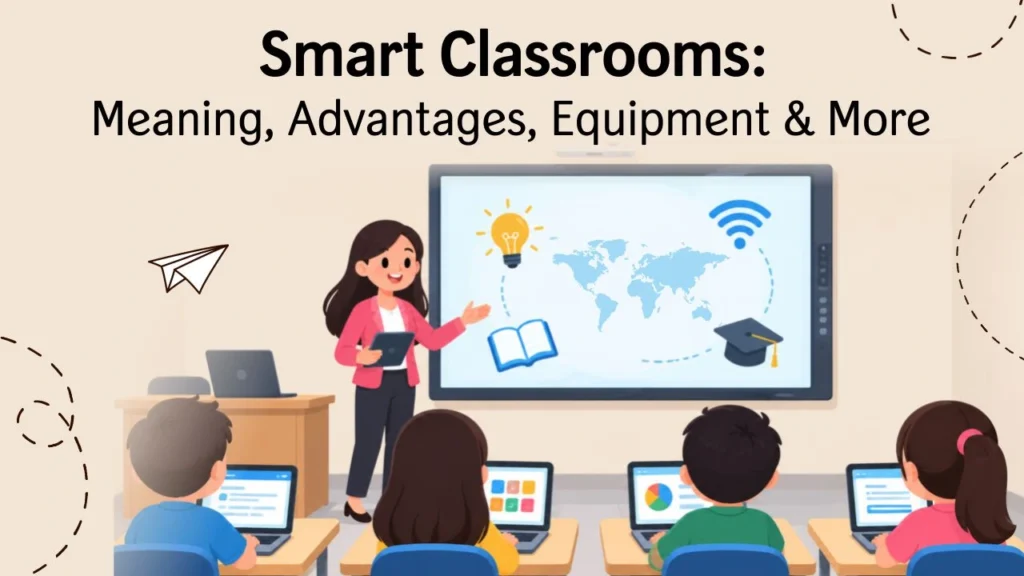
A smart classroom includes multiple pieces of technical equipment, such as smartboards, podiums, projectors, audio systems, interactive screens, and more. All this equipment helps in providing a much simpler and more efficient learning experience for the students, ultimately helping to save more time while simultaneously improving their academics.
A smart classroom acts as a bridge between technology and traditional schooling, bringing the two closer than ever to elevate the learning experience of students. Many schools, like K.R. Mangalam World School, have been using smart classrooms to teach their students in a much more effective and productive manner.
What are the advantages of smart classrooms in modern education?
In modern times, smart classrooms have become an important part of the education system, where they’ve become a strong connective bridge between education and technology. Smart classrooms have emerged as the perfect solution to foster interactive, multimedia-oriented teaching that can make even the most complex concepts a piece of cake.
It has also proven highly effective in promoting a smooth transition into the upcoming era of technology and automation, where paper will be replaced by tablets and e-notebooks.
There are many other reasons why smart classrooms are becoming more and more popular among schools:
Instant Results and Feedback
Students can take online assessments and evaluate their performance to identify their weaknesses and work on them.
Access to Online Resources
Students can enjoy access to multiple online resources based on their curriculum. These resources can come in handy for remote learning.
Better Productivity
Smart classes can exponentially improve the productivity of both educators and students in multiple landscapes.
What smart classroom equipment does K.R. Mangalam World School in Panipat?
Being one of the best schools in Panipat, K.R. Mangalam World School enjoys tech-loaded classrooms and futuristic lab facilities. Our state-of-the-art smart classrooms are well-equipped with:
Smart Presentation Boards
To offer visual learning sessions to our students so they can understand even the most complex topics in the easiest possible manner.
Spatial Audio Setup
Our smart screens are equipped with spatial audio setups to ensure our students learn through a complete audio-visual setup, promoting a multi-sensory learning attitude in the students.
Student-Friendly Podiums
Every classroom in K.R. Mangalam World School, Panipat, has a student-friendly podium that can be used by both students and teachers to present and control the smart boards installed in the classroom.
High Definition Projectors
We’ve installed high-definition projectors in all our classrooms to ensure crisp image projection for detailed understanding.
Brighten your child’s future by applying at K.R. Mangalam World School, Panipat today!
What is the difference between traditional and smart classrooms?
Although we have discussed in length about smart classrooms and the modern way of learning, let’s not forget that many schools still offer traditional learning formats. So, Indian classroom teaching and learning methods can be classified into smart and traditional classroom settings.
Is a smart classroom better? Isn’t the older method more effective? All such doubts will be resolved below. Let’s quickly look at the difference between traditional and smart classrooms in the table below.
| Traditional Classrooms | Smart Classrooms |
| Traditionally, classrooms have white or black boards with chalk, markers, etc., to teach children. | In a typical smart classroom, equipment like projection screens, styluses, podiums, and audio systems are used. |
| Educators can teach through traditional methods that include speaking, listening, and writing. | Teachers can incorporate audio-visual elements in their teaching methods to educate their pupils. |
| Traditional teaching methods usually struggle to keep students hooked, often resulting in less attentiveness. | The setup of a smart classroom creates the perfect environment for the students to pay attention and learn much more effectively. |
| Students usually can’t engage much through traditional teaching methods. | Students can engage much more freely in the classroom through their devices and even track their progress through apps. |
Conclusion
The benefits of having a smart classroom extend beyond just convenience. It creates a dynamic and interactive learning experience for students as well as educators. It can help educators make their lectures more detailed through multi-sensory learning and develop essential digital skills among the students, preparing them for the tech-driven future that’s about to come.
Frequently Asked Questions
What are the main features of smart classrooms?
The main features include a few pieces of equipment for a smart classroom, such as a smart board, lesson audio and video recorder, speakers and amplifiers. Besides hardware, interactive software, screen sharing, and cloud-based resources are a must.
Are all schools transitioning into smart classrooms?
Yes! Most schools like the K.R. Mangalam World School, Panipat, have already started to realise the importance of smart classrooms and have begun incorporating the same in their premises.
What benefit will my child get if they study in a smart classroom?
Admitting your child to a school with smart classroom facilities can be a great decision, as such classrooms can easily help a child expand their knowledge much more effectively through audio-visual teaching methods.
What equipment does a smart classroom have?
Usually, a smart classroom has equipment like an interactive panel, a projector, a digital podium, an interactive pad, a stylus, and an audio system.
What are the different types of smart classrooms?
There are three main types of smart classrooms: Standard Smart Classroom, Intermediate Smart Classroom and Student-Led Smart Classroom.
Are smart classrooms more effective than traditional teaching methods?
Both traditional and smart classrooms have their own benefits, and combining the two settings can bring the best of their effectiveness.
Are there any drawbacks of smart classrooms?
There are some drawbacks of smart classrooms, such as high financial cost, technical issues, challenges with training teachers, less creativity, less connection with others and increased distractions.
Does K.R. Mangalam World School have smart classrooms?
Yes. Counted among the top schools in Panipat, KRMWS absolutely has interactive classrooms, a digital library and resources and age-appropriate interactive environments for young ones.
What equipment does the school possess?
K.R. Mangalam World School in Panipat is equipped with modern teaching tools, including smart boards, sense boards, and e-learning resources.