We are all aware of the basic meaning of globalization. It connects the world, making almost everything accessible to everyone. Globalization in education allows students to access knowledge, technology and even skills. This broadens their perspective and exposes them to diverse cultures, ideas and learning methodologies. It prepares them to thrive in the global workplace, promoting innovation and collaboration.
Moreover, with globalisation, schools like K.R. Mangalam World School, Panipat, get a chance to update their curriculum, teaching methods, and schooling technologies so that their students can prepare and get their hands on all the opportunities in the world.
In this blog, we’ll dive into the concept of globalisation in education and its impact.
Quick Glance At the Blog
Below is the tabular overview for you to navigate across the blog sections such as meaning, impact and goals of globalization on education. We hope this readable and comprehensive format makes the reading process easier.
| Sections | Details |
| What is globalisation in education? | Learn the meaning of globalization in an educational context. |
| What is the impact of globalization on the education system? | Explore both the positive impact and the challenges faced due to globalization in education. |
| What are the core goals of globalisation in education? | Listed the major goals of globalization in education. |
| K.R. Mangalam World School, Panipat: Embracing Globalisation in Education | Discover how KRMWS has embraced gloablization. |
| Conclusion | Concluding words of the write-up. |
| Frequently Asked Questions (FAQs) | Answer common questions related to globalization in education. |
What is globalisation in education?
With the changing world, the education industry has changed, affecting every aspect of learning and education in any institution. The more we connect with the world, the more we learn and the more we have to offer to the next generations. This process of learning from across borders and passing that global knowledge to students across the globe is called globalisation in education.
What is the impact of globalization on the education system?
Globalisation has impacted the education system in many ways that are both positive and challenging. Some of the impacts of globalisation in education have been discussed below:
Positive Impacts of Globalisation on Education
- Access to Information Across the Globe
Globalisation facilitates access to vast educational resources through the Internet, digital libraries, textbooks, and online courses, enabling students from around the world to learn from leading institutions and experts from the comfort of their homes.
- Cultural Exchange
Globalisation promotes cultural exchange, allowing students to learn about diverse cultures, languages, and perspectives, leading to global awareness and intercultural communication skills.
- Improved Educational Standards
The global competition for quality education pushes institutions to adopt best practices and high standards, resulting in improved curricula and teaching methods worldwide.
- Better Learning Opportunities
Globalisation has expanded learning opportunities with the medium of online courses and educational platforms accessible globally, allowing students to enrol in programmes that may not be available locally.
- Integration of Technology in Education
Globalisation has accelerated the adoption of modern educational technologies, such as online learning platforms, virtual classrooms, and AI-driven teaching tools, making education more accessible than ever with enhanced engagement of students.
Challenges Brought by Globalisation in the Field of Education
Here are some of the challenges brought by the introduction of globalisation in the field of education:
- Migration Becomes More Common
Globalisation encourages the migration of skilled students and professionals to more developed countries for a better quality of education and job opportunities, leading to a loss of talent and expertise in relatively less developed countries and regions.
- Digital Differences
Despite the spread of technology, many underdeveloped countries face limited access to the internet and digital tools, creating a gap between those who can benefit from online education and those who cannot.
- Standardisation of Education
Globalisation pushes for standardised curricula and testing methods, which may not be enough for local needs or individual learning styles, potentially stifling creativity and innovation in education.
- Language Barrier
With globalisation, English has become an international language for communication, establishing its dominance over any other language in the world. The dominance of English and other major languages in global education platforms can disadvantage non-native speakers, limiting their ability to fully engage with or benefit from educational opportunities.
- The Commercialisation of Education
Globalisation has contributed to the commercialisation of education, where private institutions prioritise profit over quality and equity, leading to the exclusion of marginalised groups and undermining public education systems.
This is why it is important that you choose a school like the K.R. Mangalam World School, Panipat, that focuses on offering quality education without prioritising profit-making.
What are the core goals of globalisation in education?
Many revolutions were brought about by globalisation in the field of education, and with time, they evolved into goals. Some of the core goals of globalisation in education have been mentioned below:
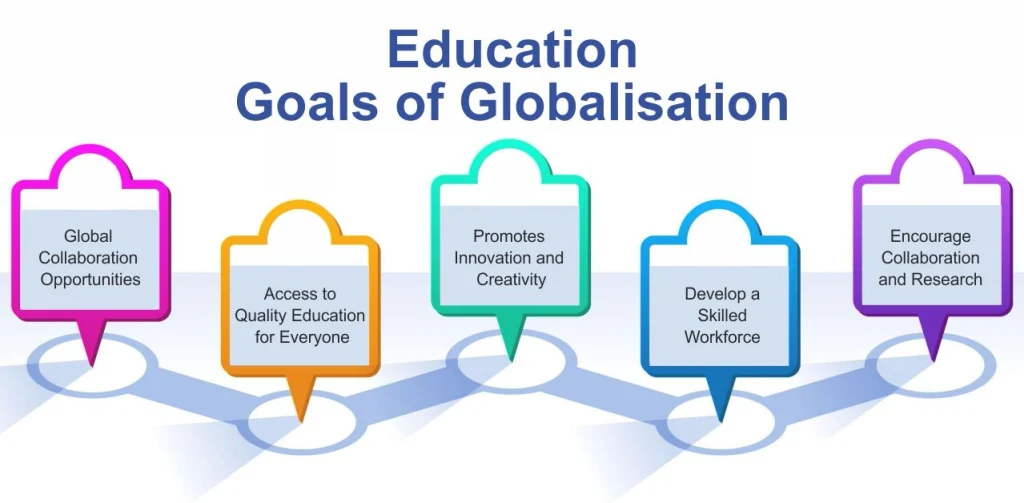
Global Collaboration Opportunities
Globalisation in education aims to develop students’ understanding of global issues, cultures, and perspectives, fostering a sense of global responsibility, empathy, and the skills needed for cross-cultural collaboration.
Access to Quality Education for Everyone
One of the key goals of globalisation is to provide universal access to high-quality education by leveraging technology, online platforms, and international partnerships, ensuring that students worldwide can benefit from the best learning opportunities.
Promotes Innovation and Creativity
Globalisation encourages the exchange of ideas, knowledge, and teaching methodologies that can inspire innovation and creativity in education, preparing students to solve complex global challenges in the future.
Develop a Skilled Workforce
Globalisation taught us about the skills and knowledge that are required to fit into global job markets and workspaces. As a result, we could develop curricula that were targeted towards developing a workforce that can prepare itself for the professional roles out there.
Encourage Collaboration and Research
One goal of globalisation is to promote international collaboration in research and development, enabling educators and researchers from different countries to collaborate on solving global problems and advancing knowledge for the betterment of society.
K.R. Mangalam World School, Panipat: Embracing Globalisation in Education
Counted among the best schools in Panipat City, K.R. Mangalam World School, Panipat reflects the true essence of globalisation in education by integrating modern teaching methodologies, technology-driven learning, and a globally relevant curriculum.
The school ensures that students are not only academically strong but also globally aware, culturally sensitive, and future-ready. By incorporating digital tools, experiential learning, and innovative classroom practices, KRMWS Panipat provides students with access to a wider pool of knowledge and learning resources.
It also encourages critical thinking, collaboration, and communication—skills that are essential in a globalised world. This progressive approach to embracing globalisation in education has positioned it as one of the top schools in Panipat.
Conclusion
Globalisation is a necessary revolution that has opened the doors to many career opportunities for all people around the globe. From allowing people to share their knowledge to the collaborative development of teaching methods, globalisation has brought some real changes in the education industry over the years.
Many CBSE schools in Panipat City, like K.R. Mangalam World School, ensure students get all the benefits that globalisation has brought to the industry. Considered as the best CBSE school in Panipat, KRMWS ensures students improve their academic performance and skills through exchange programmes, international excursion trips, etc so as to get the best career opportunities in the future.
Apply now for admission at K.R. Mangalam World School, Panipat and give your child access to global learning opportunities.
Frequently Asked Questions (FAQs)
Q1. What opportunities did globalisation in education bring to India?
In India, globalization has unlocked multiple global resources in the field of education, improving our nation’s literacy through global resources. These resources include a better global workforce, international collaborations, machinery, and devices important for offering education on a large scale.
Q2. How is globalisation influencing the Indian education system?
Globalization has strongly contributed to the modernisation of the Indian education system and the creation of learning spaces that are much more effective in helping students learn and use their knowledge.
Q3. How does globalisation help students?
It helps students develop global awareness, critical thinking, communication skills, and prepares them for international career opportunities.
Q4. Is globalisation in education good for the education industry?
Globalization didn’t only bring new education methods to India but also helped improve traditional teaching methods, update syllabi, and get access to knowledge from all over the world. Hence, it can be considered good.
Q5. Why is globalisation important in modern education?
Globalisation ensures that students are equipped with the skills, knowledge, and exposure required to succeed in a competitive and interconnected world.
Q6. Why choose K.R. Mangalam World School, Panipat?
It is considered one of the best CBSE schools in Panipat, offering a global learning environment, modern infrastructure, and a focus on holistic student development.
Q7. How does K.R. Mangalam World School, Panipat supports global learning?
KRMWS Panipat integrates technology, experiential learning, and modern teaching methods to provide students with global exposure and future-ready skills.
Q8. How can parents choose a globally focused school?
Parents should look for schools that offer a modern curriculum, technology integration, global exposure, and holistic development opportunities.
Q9. What are the fees at K.R. Mangalam World School in Panipat?
You can check out the updated KRMW School fees in Panipat on the official page.